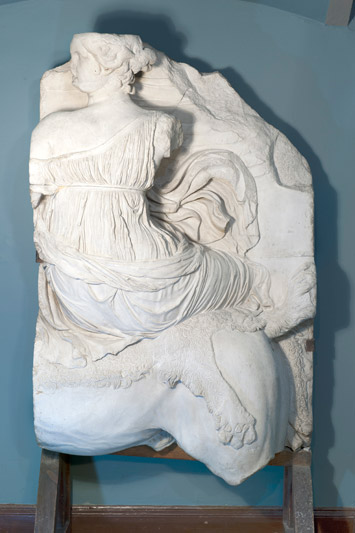


Moon goddess Selene
In the Pergamon Museum in Berlin, for more than a hundred years, there has been an impressive altar in honor of Zeus, excavated under the direction of German archaeologists. In colossal high relief, the battle between the Greek gods and their adversary the giants undulates around the structure, with a huge staircase in the center. Although the victory of the gods is never doubted, the enemy is still depicted as strong and dangerous. Among the calmer figures in the work is the moon goddess Selene riding through the night.
In the politically chaotic time around 200 BC, many looked back to the older Greek gods. The king of Pergamon erected an altar to the supreme god Zeus, whom he hoped would protect the state in times of trouble. The altar was widely known and is called "Satan's throne" in the Bible's Book of Revelation.
As far as we know, Selene was the only major cast from the Pergamon Altar acquired by the Academy of Fine Arts. She was here in 1904 and was probably one of the last large casts that were bought, before the compulsory drawing after ancient plaster casts disappeared from the Academy of Arts' schedule.